Professional B2B PR and public affairs strengthen your reputation. This is how you can ensure the long-term success of your business goals in the D-A-CH region.
What is the difference between B2B PR and B2C PR?
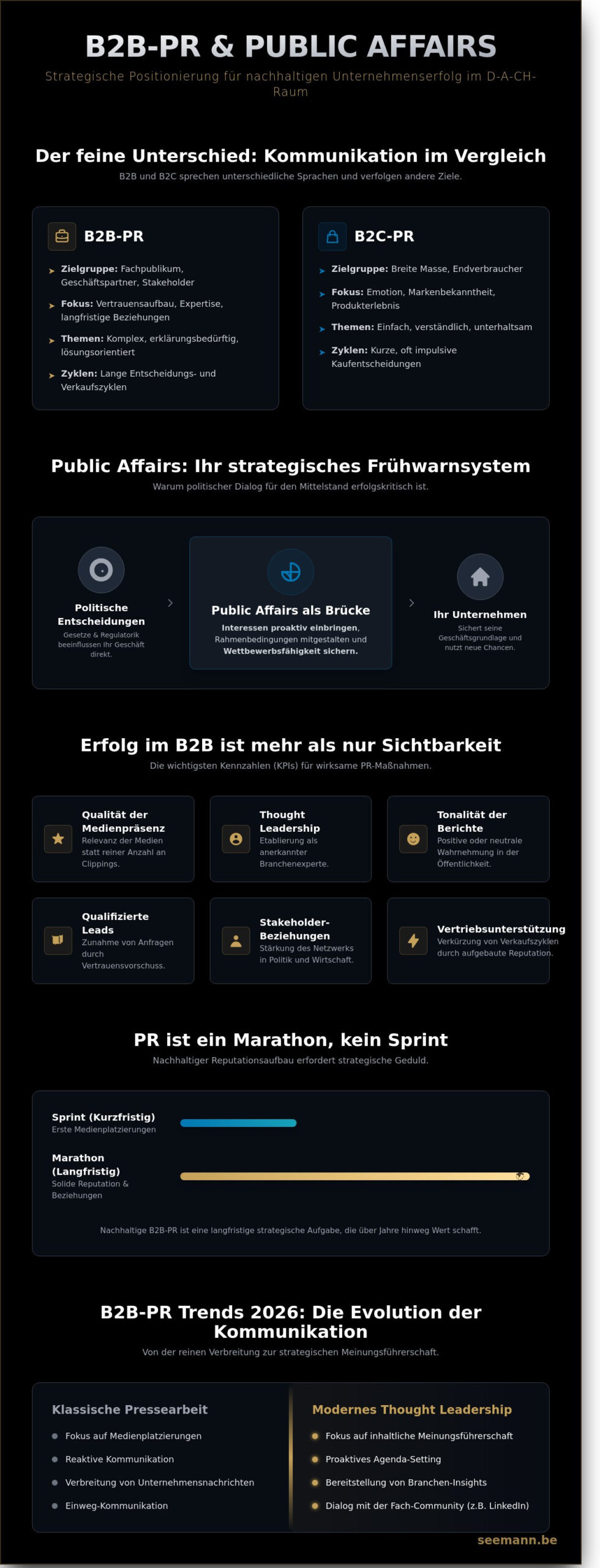
B2B PR is aimed at industry professionals and business partners. The focus is on building trust, demonstrating expertise, and fostering long-term relationships. Communication in this context is characterized by complex topics and lengthy decision-making processes. B2C PR targets end consumers; it is often more emotional and product-focused, and aims for broad visibility and quick purchasing decisions.
Why is public affairs important for small and medium-sized businesses?
Political and regulatory decisions have a direct impact on the business environment of small and medium-sized enterprises. Public affairs serves as an early warning system for legislative changes and enables companies to proactively bring their own interests into the political dialogue. In this way, small and medium-sized enterprises safeguard their competitiveness and actively help shape the conditions in which they operate.
How do you measure the success of PR initiatives in B2B?
Success is not measured solely by media coverage (clippings). Key performance indicators include the quality of media coverage, establishing oneself as a thought leader, the tone of the reporting, an increase in inquiries from qualified leads, and strengthening relationships with key stakeholders in politics and business.
How much does it cost to hire a specialized PR firm?
Costs vary depending on the scope, strategic depth, and duration of the engagement. Professional consulting is an investment in a company’s most valuable asset: its reputation. Budgeting is based on clearly defined objectives, ranging from project-based support to long-term strategic guidance.
How long does it take for PR results to become visible?
PR is a marathon, not a sprint. While initial successes, such as media coverage, can be achieved in the short term, building a solid reputation and sustainable relationships with stakeholders typically takes several months to years. Sustainable B2B PR is a long-term strategic endeavor.
Can PR directly support sales?
Yes, both indirectly and directly. A strong reputation and positioning as a thought leader shorten sales cycles because trust is already established. Targeted white papers, case studies, and presentations generate qualified leads and provide the sales team with valuable talking points for customer meetings.
What role does social media play in B2B PR?
A key one. Platforms like LinkedIn are indispensable for thought leadership, direct dialogue with stakeholders, and employer branding. Social media makes it possible to communicate complex topics to a specialized audience in a targeted manner and significantly expand the reach of core messages.
PR for B2B Companies: Strategic Positioning Rather Than Merely Visibility
Successful PR for B2B companies is more than just media relations. It is a management function focused on strategically shaping all relevant relationships. It is not about short-term visibility, but about building a long-term, resilient reputation. Where traditional advertising reaches the limits of trust, professional public relations lays the groundwork for sustainable business success. It is the foundation for a strong brand identity.
Reputation as the most valuable asset in B2B
A strong reputation is a strategic asset. It shortens complex sales cycles, because trust is the key currency in demanding decision-making processes. Companies that are perceived as credible experts have less work to do to convince others. Proactive communication also protects against reputational risks and strengthens resilience in times of crisis.
Target audiences beyond customers
Your success depends on a complex network of stakeholders. A thorough stakeholder analysis identifies who truly influences your business development. In addition to customers, investors, business partners, policymakers, and potential employees are key target groups for your communications. Consistent internal communication is essential for a credible public image.
The Synergy of Public Relations and Public Affairs
Today, business success is inextricably linked to the political landscape. Regulatory changes, proposed legislation, and social trends directly influence markets. Public affairs serves as a strategic early warning system in this context. It enables companies to engage in targeted dialogue with policymakers and to represent their interests effectively. An example illustrates this: A new EU directive on sustainability reporting can pose significant challenges for unprepared SMEs in the D-A-CH region, while informed companies leverage the new requirements as a competitive advantage.
Political Communication for Small and Medium-Sized Businesses
Small and medium-sized enterprises must take an active role at the intersection of business and politics, rather than merely being passive observers. The key to making their voices heard in Brussels and Berlin is evidence-based reasoning. Facts, data, and clear positions form the foundation for a successful dialogue. A strategically built network, such as in the Euregio Meuse-Rhine, provides the necessary access to decision-makers.
Strategic consulting as a foundation
Operational tactics such as press releases or events are ineffective if they are not embedded in an overarching political strategy. First, the goals must be clearly defined: What exactly should public affairs achieve for your company? The Seemann law firm acts as a bridge between these worlds, translating business objectives into effective political communication.
B2B PR Trends for 2026: Authenticity and Evidence
The future of B2B communication lies in combining technical depth with a clear stance. The goal is to be perceived as an authentic and evidence-based voice in the market.
| Traditional public relations | Modern Thought Leadership |
|---|---|
| Focus on media placements | Focus on thought leadership in content |
| Reactive Communication | Proactive agenda-setting |
| Distribution of corporate news | Providing industry insights |
| One-way communication | Dialogue with the professional community |
The use of AI can make processes in analysis and distribution more efficient, but human expertise in strategy, relationship-building, and nuanced communication remains irreplaceable. Data-driven PR is the foundation, but facts alone are not enough to convince. They must be embedded in a clear and relevant narrative. Visual storytelling helps present complex B2B content in an aesthetically pleasing and clear manner.
Thought Leadership as a Strategy
Position your leadership team as sought-after experts in relevant trade publications and on key platforms. Create content with real substance that offers your target audience new perspectives and solutions—moving away from generic, run-of-the-mill content. Use professional networks like LinkedIn and targeted industry forums to share your expertise and engage directly with your industry.
Crisis Communication in the Digital Age
The best crisis communication is prevention. Continuously monitoring political and social trends helps identify potential risks early on. In an emergency, the art of responding calmly is crucial: speed must never come at the expense of care. After a crisis, systematic reputation management is necessary to systematically rebuild lost trust.
The Path to an Effective B2B PR Strategy: A 5-Point Plan
An effective strategy is the result of a disciplined process. It serves as the foundation upon which all operational measures are built.
- Status Quo Analysis: Where does your brand stand today? The starting point is an honest assessment of your current brand perception, your competitors, and the relevant market environment.
Such fundamental analyses are often part of a broader strategic realignment, where specialized consulting firms can provide assistance. For insights into the methodology behind such executive consulting approaches, see, for example, michelboutin.co. - Defining Objectives: What exactly should the communication achieve? Define clear, measurable objectives and the corresponding key performance indicators (KPIs), such as increasing recognition as an industry expert.
- Developing Core Messages: Formulate your key messages. They must be precise, powerful, and consistent over time. They serve as the common thread running through all your communications.
- Channel Selection and Coordination: Where can you most effectively reach your stakeholders? Choose the right channels—from trade publications and political bodies to digital platforms—and coordinate your efforts.
- Monitoring Progress and Adjusting: Communication is a dynamic process. Regularly review your progress toward your goals using your KPIs, and flexibly adapt your strategy to changing conditions.
Messages that stick
Develop a clear corporate messaging style. The key is to use clear, minimalist language that gets straight to the point. Avoid generic buzzwords and instead demonstrate genuine expertise. Consistency in your messaging across all touchpoints is crucial for building a strong and recognizable brand identity.
Action Planning and Budgeting
The selection of PR measures depends on the current stage of your business cycle. A startup requires different tools than an established market leader. The budget calculation for professional B2B PR reflects a strategic investment in your reputation. The timeline must be realistic: successful public relations is a marathon, not a sprint.
Tailored communication for the German, Austrian, and Swiss markets
Cross-border PR between Belgium, Germany, Austria, and Switzerland requires a deep understanding of local nuances. Cultural subtleties in engaging with the media, business partners, and political stakeholders are often crucial to success. It is essential to understand the subtle differences in political communication and the media landscape and to leverage them strategically. The Seemann approach is based on the principles that matter in this environment: composure, precision, and deep expertise. A regionally rooted partner with an international network makes all the difference here.
Expertise from Eupen for Europe
Eupen’s strategic location at the crossroads of European markets is a key advantage. From here, we can effectively serve both German- and French-speaking markets. As an owner-managed consulting firm, we guarantee personalized support and direct accountability. Our references and success stories from the region demonstrate our expertise in successfully positioning local companies on the European stage.
Your next step toward a strong brand
When is the right time to seek external strategic consulting? Whenever you’re growing, undergoing change, or looking to secure your market position for the long term. During an initial one-on-one consultation, we’ll work together to identify your brand’s potential and define the strategic levers for your success.