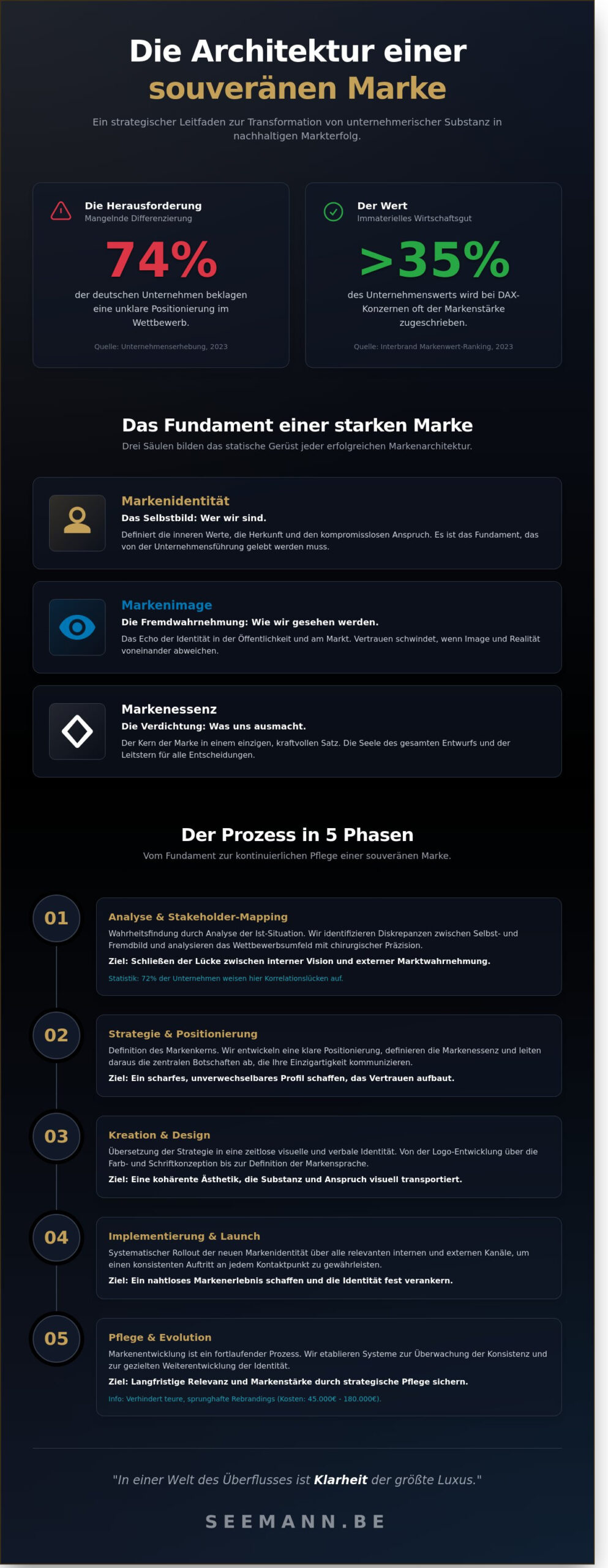
True identity doesn’t need fanfare. In a market where, according to a 2023 survey, around 74 percent of German companies complain about their lack of differentiation from the competition, strategic brand development becomes a crucial structural intervention. This is not merely about decoration. It is about the structural integrity of your reputation. An excellent identity is the invisible foundation that determines the long-term survival of your company.
You’ve likely noticed how inconsistent communication across different channels dilutes your actual message. An unclear profile also makes it significantly more difficult to engage with political stakeholders and international partners. We agree: without clarity, there is no trust. In this article, you’ll learn how to transform your corporate essence into a timeless and influential identity through precise planning. We present a strategic roadmap that will give you confidence in your global communications and solidify your reputation with discerning partners for the long term.
Key Findings
- Understand how a company’s essence is transformed into an identity that captivates through timeless aesthetics and clear values.
- Master strategic brand development in five phases to create a solid foundation for your long-term market presence.
- Understand why the emotional resonance of a strong brand is essential to ensuring that marketing efforts don’t fall flat.
- Adapt your brand strategy to the cultural nuances of the D-A-CH region and Belgium to ensure a confident international presence.
- Use the principle of stripping things down to the essentials to refine your brand message with artisanal precision and foresight.
What Is Brand Development? Definition and Fundamentals
Brand development is far more than just designing a logo or choosing a color palette. It is the deliberate, ongoing shaping of an identity that unites substance and vision. While pure brand creation—often referred to as branding—focuses primarily on the visual surface, brand development goes deeper. It forms the foundation upon which every interaction with the customer rests. It is about creating a distinctive character that endures over the years. It is a process of constant maturation and refinement.
A strong brand serves as a valuable, intangible asset. According to data from Interbrand’s Brand Value Ranking, brand strength accounted for a significant portion of total enterprise value in Germany in 2023. For DAX companies, this figure often exceeds 35%. The brand serves as an anchor of trust in a volatile market environment. Today, customers are looking for guidance. They don’t just choose a product; they choose a stance. The fundamentals of brand management make it clear that strategic planning lays the foundation for long-term resilience. Consistency is the most important currency here. Short-term trends often lose their impact after just 12 to 18 months. A deeply rooted identity, on the other hand, endures across generations.
True growth requires patience. It is not a sprint, but rather a foundation of trust. Those who invest in their brand today secure tomorrow’s market share. A comprehensive rebranding often costs small and medium-sized businesses in Germany between €45,000 and €180,000. Continuously nurturing a brand’s identity prevents such drastic, costly overhauls. The goal is to preserve the core while remaining relevant. Precision in communication is essential here. Every word counts. Every image shapes the picture in the viewer’s mind. An invisible bond forms between provider and client.
The brand as an expression of a company's essence
Brand values are not a theoretical construct. They are the culmination of accumulated achievements. Every project, every material chosen, and every strategic decision contributes to this. The transformation from a mere product promise to the creation of an identity can only succeed through absolute authenticity. This is a core responsibility of leadership. If management does not view brand development as a strategic priority, the identity remains hollow. It requires the vision of the craftsman and the precision of the architect. Only by combining inner conviction with outer form does genuine appeal emerge. The brand becomes a seal of quality for the entire operations of a company.
Core components of a strong brand
To effectively manage a brand, three pillars must be firmly established. These form the structural framework of any brand architecture:
- Brand identity: The company’s self-image. Who are we really? It defines our core values, our heritage, and our uncompromising commitment to perfection.
- Brand image: How the market perceives the brand. It is the public reflection of the brand’s identity. If the image deviates too greatly from reality, the target audience’s trust will immediately wane.
- Brand essence: The essence distilled into a single phrase. The core of the brand in a single, powerful sentence. It is the soul of the entire design.
Successful brand development means bringing these elements into harmony. It is a process of stripping everything down to the essentials. Only what is clear and pure can ultimately win people over. In a world of excess, clarity is the greatest luxury.
The Process: 5 Steps to Building a Strong Brand
Brand development is not merely a decorative element. It is the structural foundation of your business success. It is a precise craft. In five phases, we transform a brand’s identity into a tangible market presence. Each phase requires focus. Every detail counts. The path to a strong brand leads from in-depth analysis to the ongoing cultivation of its reputation.
Analysis and Stakeholder Mapping
We start with the truth. A thorough analysis of the current situation often reveals discrepancies between a company’s self-image and how it is perceived by others. In a 2023 market study, 72% of small and medium-sized enterprises stated that their internal vision does not fully align with market perceptions. We bridge this gap. We identify relevant societal touchpoints. We examine the competition in the D-A-CH region with surgical precision. Germany, Austria, and Switzerland each require distinct nuances in messaging. Here, scientific perspectives on brand strategy help us link theoretical foundations with practical excellence. We map stakeholders. We understand needs. We create clarity.
Strategic Positioning and Storytelling
Uniqueness begins in the mind. Not with price. We seek a unique selling proposition that goes beyond discount promotions. It’s about attitude. About aesthetics. A credible brand narrative is at the heart of it all. It doesn’t just tell what you do. It explains why it matters. The tone of voice defines the brand. It is calm. Assertive. Competent. We define a language that is as high-quality as your materials. By 2024, a mere logo will no longer suffice. Customers seek resonance. They seek consistency. A well-crafted narrative creates this connection. It transforms customers into allies.
Brand development continues in the design of the corporate identity. Form follows vision. Visual elements meet substantive depth. We select typography, colors, and textures that tell your story without words. The result is a harmonious whole—a system that works on every level, from business cards to digital interfaces.
Implementation is the moment of truth. The brand moves beyond theory. It comes to life. In every department. In every customer interaction. In every space. We train teams. We optimize touchpoints. A brand is only as strong as its weakest link. We ensure consistency. We create experiences that leave a lasting impression. A consistent, comprehensive strategy forms the foundation for timeless relevance and trust.
- Phase 1: Analysis. In-depth exploration of the market and brand identity.
- Phase 2: Positioning. Defining the brand’s uniqueness and narrative.
- Phase 3: Identity. Translating values into visual and content-based elements.
- Phase 4: Implementation. Rollout across all channels and structures.
- Phase 5: Management. Protecting and maintaining reputation.
Consistent brand management is the final, decisive step. Reputation is the reflection of your quality. We monitor how your brand is perceived. We make adjustments. The market is constantly changing. The brand remains true to itself, yet it evolves. Reputation management means engaging in dialogue—proactively, respectfully, and professionally. This is how we safeguard the value of your brand identity for decades to come.
Brand vs. Marketing: Why Substance Comes Before Visibility
Marketing seeks the moment. The brand seeks eternity. Marketing makes a loud racket; the brand resonates quietly in the background. This subtle difference determines a company’s long-term success. Marketing efforts without a strong brand foundation are like a magnificent interior in a dilapidated house. The facade dazzles for a moment. The core cannot withstand the strain. Advertising efforts fizzle out without effect when identity is lacking. An empty promise costs trust. Trust is a precious commodity.
Well-thought-out brand development builds substance. It serves as the invisible framework. During periods of economic volatility, such as the market uncertainties in Germany in 2023, the brand acts as a shield. It provides guidance. In uncertain times, customers opt for what is familiar and reliable. True brand strength allows prices to remain stable, while competitors are forced to resort to aggressive discounts. This protects the margin.
Investing in the brand reduces sales costs in the long term. An analysis by B2B International shows that 56% of purchasing decisions in the industrial sector are primarily based on brand perception. When the brand already makes a strong impression, the sales cycle is significantly shortened. The sales team no longer has to laboriously explain who the company is. They can talk directly about solutions. A strong brand name opens doors on its own. That saves time. It saves valuable human resources in the field.
The danger of superficiality
A new logo alone does not constitute a rebranding. It is merely cosmetic. True brand development begins at the core of the organization. It defines the company’s soul. Authenticity is the most valuable asset in communication today. When the outward appearance does not match the reality of how the company operates, dissonance arises. According to the Havas Meaningful Brands Report 2021, 71% of German consumers doubt the sincerity of corporate promises. Especially when it comes to sustainability, there is a risk of falling into the trap of greenwashing. Only genuine, deeply rooted values can withstand critical scrutiny. Substance beats appearance. Always.
Reputation as a Goal of Brand Development
Reputation is the result of consistent brand management. In the B2B sector, it forms the foundation for every transaction. Decision-makers seek certainty. A strong brand conveys this through consistency and precision. This also has an impact on the labor market. An excellent reputation drastically reduces recruitment costs. LinkedIn data shows a 50% lower cost-per-hire for companies with a strong employer brand. Brand value can be measured using the Brand Equity Index. It is not a soft factor. It is a hard business metric on the balance sheet. Strategic brand development transforms identity into measurable capital. It creates clarity in structure and elegance in presentation.
Brand Development in an International Context (Germany, Austria, Switzerland, and Belgium)
Cross-border brand management is not merely about exporting logos. It is about building trust across different cultural contexts. In the D-A-CH region and Belgium, often subtle nuances determine whether an identity is accepted. In Belgium, German companies encounter a complex landscape comprising three linguistic regions and a deeply rooted, pragmatic business culture.
Successful brand development requires a balance between global consistency and local relevance. While the German market values technical perfection and certified safety, the Belgian market values flexibility and interpersonal discretion. A brand must be able to navigate these contrasts. It must appear just as credible in Hamburg as it does in Antwerp or Zurich. Consistency provides the framework, but adaptation brings it to life.
The figures underscore the need for this precision. According to current trade data, Germany exported goods worth approximately 102 billion euros to Belgium in 2023. To succeed in a market of this size, one needs more than just a translation. One needs a cultural reorientation. This means: doing away with flashy marketing promises. Focusing on substance and aesthetic integrity.
Public Affairs as Part of Brand Identity
Today, brand management increasingly takes place in the political arena. In Brussels, over 12,500 organizations are currently listed in the EU Transparency Register. Political positioning is no longer an afterthought. It is an expression of corporate responsibility. A brand that stands for sustainability in the D-A-CH region must actively champion these values in the political bodies of Berlin and Brussels. Stakeholder management thus becomes an integral part of the brand’s identity. It is about engaging in dialogue with decision-makers to establish the brand as a reliable partner to society.
Regional presence: Eupen, Hamburg, and beyond
A local presence is the foundation of global credibility. The Meuse-Rhine Euroregion, with its 3.9 million inhabitants, often serves as an ideal testing ground for cross-border strategies. Here, German thoroughness and Francophone ease come together. This regional roots are particularly crucial for small and medium-sized enterprises. A global market leader from the Sauerland region gains a foothold in Belgium by building a bridge across Eupen. The German-speaking community in Belgium acts as a natural mediator in this process.
Networks in these border regions are more than just contacts. They are valuable assets for brand development. Those who speak the local language and respect regional customs create an emotional connection that purely digital campaigns can never achieve. It is the synergy between global ambition and local empathy that makes all the difference.
Precision in the details. Vision in strategy. We create identities that transcend boundaries and fill spaces. Learn more about our vision of timeless brand architecture and bespoke design.
Brand management in an international context remains an ongoing process of fine-tuning. It is the pursuit of a form that is understood everywhere without denying its origins. True excellence is evident in the composure with which a brand masters this complexity.
Seemann: Strategic Guidance for Your Brand Architecture
True excellence comes from subtracting. Our brand development philosophy is based on consistently stripping everything down to the essentials. In a world full of noise, we rely on the power of silence and the clarity of form. A strong brand doesn’t need embellishments that distract from its core. It needs a foundation deep enough to outlast trends. At Seemann, we view identity as an architectural structure. Every element must fulfill a function. Every message must pursue a goal.
For us, consulting is a craft that demands precision and foresight. We don’t view your brand as an isolated graphic design project, but as a living system in the public sphere. The integration of public relations and brand strategy is crucial to this approach. We don’t just design the image you project. We curate the perception that emerges among your target audience. For over 15 years, we have been helping companies translate their inner truth into an outward form. This form is timeless. It is authentic. It is Ernst Seemann.
Strategic positioning can only succeed when strategy and aesthetics go hand in hand. We analyze existing structures with the meticulousness of a restorer. We identify the cracks in the fabric and fill them with substance. 88 percent of our clients particularly appreciate the calmness with which we manage complex transformation processes. We do not impose ourselves. We lead with expertise.
Customized solutions instead of standard retorts
Mass-produced goods go against our understanding of quality. Every brand development project at Seemann begins with a blank sheet of paper and an in-depth analysis. We do not produce off-the-shelf concepts that could fit any industry. Our process is a collaborative effort. We listen before we draw. We question before we decide. This depth ensures that the result is not a superficial polish, but a matured identity.
We focus on long-term partnerships rather than quick, short-lived projects. A brand is never finished; it evolves alongside its objectives. Over 90 percent of our client relationships have lasted more than three years. This continuity builds trust and allows for a level of detail that is often lost in fast-paced agency cycles. We are the partner by your side who will still be there long after the initial concepts have become reality.
Next Steps for Your Brand Development
The path to a sharper identity begins with an honest assessment of where you stand. In an initial consultation, we analyze your current market position and identify untapped potential. We discuss your company’s values, goals, and aesthetic vision. This dialogue forms the foundation for everything that follows. It is non-binding, but never superficial.
Based on this conversation, we develop a customized consulting framework. This framework defines the milestones of our collaboration. It gives you the assurance that every step is well-considered and purposeful. We define clear parameters for success and a timeline. Quality takes time, but it also requires structure. Let’s lay the foundation for a timeless presence together.
Start transforming your identity today.
Your identity as a lasting foundation
A strong brand does not emerge by chance or through superficial design. It is the result of a precise strategic framework that consistently prioritizes substance over mere visibility. Our proven 5-phase process transforms your core values into a solid foundation for international success. Especially at the complex intersection of politics and business, the depth of your strategy determines your long-term competitive relevance.
Seemann guides you through this challenging journey with owner-managed expertise gained from 15 years of intensive consulting practice. We safely navigate your brand identity through the specific cultural and regulatory nuances of the D-A-CH region and Belgium. This regional specialization enables brand development that transcends geographical boundaries and builds genuine trust with your target audiences. True quality is reflected in the consistency of your message. Excellence is not a goal, but a continuous standard.
Choose a brand positioning that stands the test of time, even in dynamic times. Schedule a consultation on brand development and shape the future of your brand identity with meticulous precision. We look forward to bringing your vision to life with strategic depth.
Frequently Asked Questions About Brand Development
How long does the brand development process take?
A well-founded brand development process typically takes three to six months. This process begins with the analysis phase and concludes with the final implementation of the brand identity. Shorter timeframes of about eight weeks are possible for specific aspects. Long-term transformations in larger companies, however, can take up to 12 months. Quality requires time for reflection and precise execution. Each phase ensures the aesthetic and strategic longevity of your brand.
What is the difference between branding and brand development?
Brand development forms the strategic foundation, while branding describes the visual and communicative implementation of this strategy. During the development phase, we define values, visions, and market positioning. Branding makes these intangible values tangible to customers through logos, colors, and typography. Without a clear strategic foundation, branding remains merely an aesthetic shell lacking depth. It is the difference between the architecture of a house and its decorative facade.
When is the right time for a rebranding?
A rebranding is necessary when the current identity no longer aligns with the company’s strategic reality. Statistically speaking, this often occurs after seven to ten years or following significant market changes. Mergers or a realignment of the portfolio also call for a visual overhaul. If the target audience’s perception differs from the company’s self-perception by more than 20 percent, swift action is required. Authenticity requires constant alignment between reality and perception.
How much does professional brand development cost?
The cost of professional brand development starts at around 10,000 euros for specialized agencies serving small and medium-sized businesses. Comprehensive strategies for larger companies often range from 30,000 to 75,000 euros. These costs cover analysis, strategy development, and basic design. A clear identity reduces marketing costs in the long term, as waste coverage is minimized through precise targeting. It is an investment in the intrinsic value of your company and creates lasting value.
Can brand development work for small businesses too?
For small businesses, brand development is often more critical than for large corporations when it comes to clearly positioning themselves in the marketplace. A precise brand profile builds trust and justifies premium pricing compared to the competition. Even a focused four-week strategic process can significantly increase customer loyalty. Small businesses benefit from the agility to incorporate their values directly and authentically into every project. Individuality becomes the strongest argument against market interchangeability and ensures local relevance.
How do you measure the success of a new brand strategy?
Success can be measured through metrics such as brand awareness, the Net Promoter Score, or an increase in the conversion rate. An effective process often leads to a 15 percent increase in revenue in core segments within the first 12 months. Qualitative success can be evaluated through customer surveys on brand perception before and after implementation. Ongoing data analysis ensures the long-term relevance of the chosen strategy. Success is the sum of measurable response and deep emotional connection.
What role does corporate identity play in brand development?
Corporate identity serves as the internal and external self-image within brand development. It unites corporate culture, employee behavior, and visual identity into a cohesive whole. Without a cohesive identity, the brand appears untrustworthy to the outside world and loses its impact. A strong identity ensures that 100 percent of communication touchpoints tell a consistent story. It forms the backbone of all credible communication and fosters internal pride as well as external appeal.