Learn how public affairs, as a strategic framework, shapes the interface between business, politics, and society.
What Are Public Affairs? A Definition of the Strategic Interface
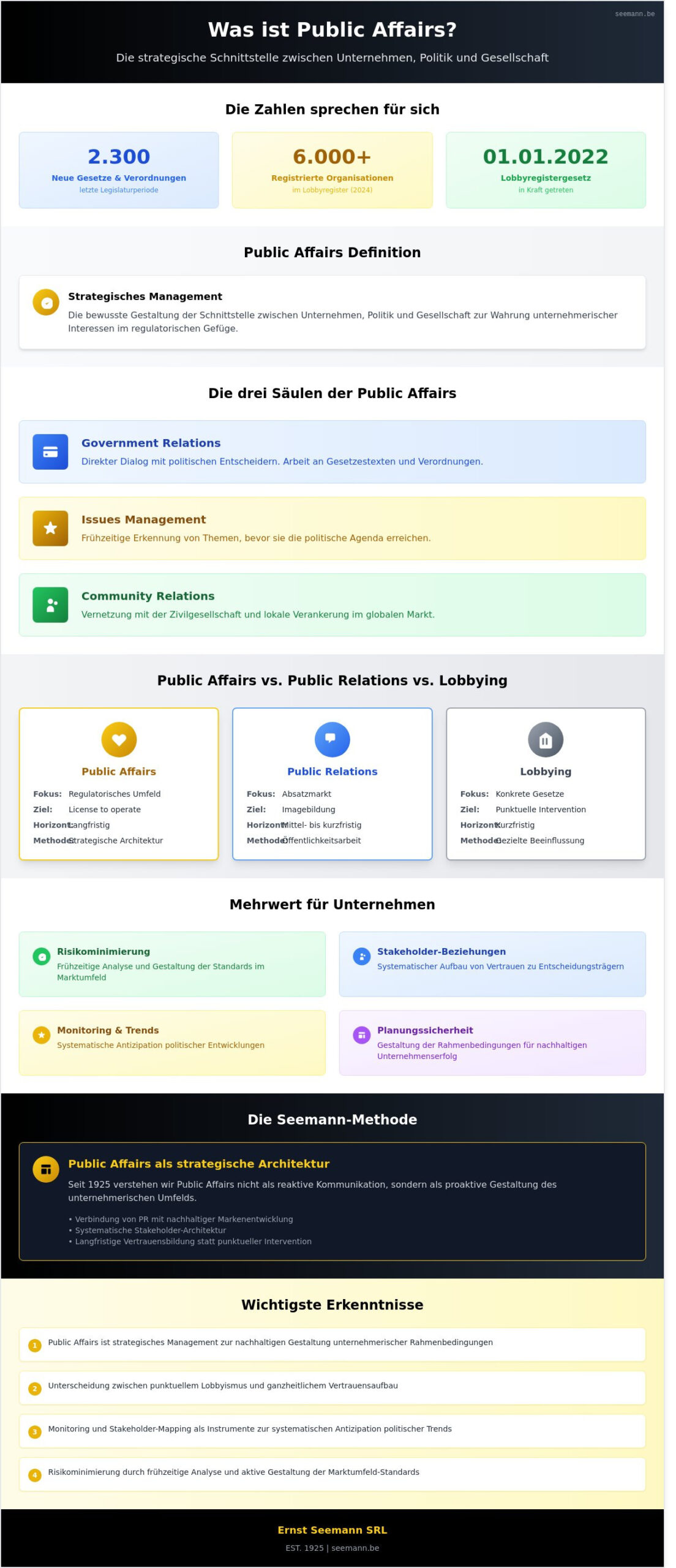
Public affairs is the strategic management of decision-making processes at the intersection of politics, business, and society. It is not about exerting short-term influence, but rather about carefully building and maintaining relationships within the political and regulatory sphere. At its core, public affairs involves proactively shaping the framework conditions that are critical to business operations.
This discipline goes far beyond traditional public relations. While PR shapes public opinion, PA shapes the environment in which that opinion takes on significance. You can think of public affairs as a highly precise navigation system that guides companies safely through complex regulatory landscapes.
The Three Pillars of Public Affairs
Successful public affairs rests on three fundamental pillars that are interlinked:
-
Government Relations: Direct, structured dialogue with policymakers at all levels—from local government to institutions in Brussels.
-
Issues Management: The early identification of social and political issues that could become relevant to one’s own company, and the active engagement with these issues by taking well-informed positions.
-
Community Relations: Strategic networking with relevant civil society actors, associations, and other stakeholders to build alliances and ensure social acceptance.
Public Affairs vs. Public Relations: Where Is the Line?
The distinction between public affairs and public relations is fundamental to a strategic understanding. While the two disciplines target different arenas and stakeholders, they complement each other in practice.
-
Public Relations (PR) is primarily aimed at the general public, customers, and target markets. Its goal is to build brand awareness and trust in order to promote commercial success.
-
Public Affairs (PA) focuses on the political and regulatory environment and its key players: parliaments, government agencies, regulatory bodies, and NGOs. The goal is to secure the company’s freedomto operate.
A strong brand requires a synergy between these two disciplines. While PR tells the brand’s story, PA ensures that the brand will continue to have a platform from which to tell that story in the future.
Lobbying vs. Public Affairs: The Subtle Difference in Communication
The terms "lobbying" and "public affairs" are often used interchangeably, but this oversimplifies the matter. Lobbying is a legitimate tool, but it is only one component of the broader framework of public affairs.
-
Lobbying as a subset: Refers to the targeted and direct representation of interests in connection with specific legislative proposals or political decisions.
-
Public affairs as a holistic approach: This involves building trust, reputation, and strategic relationships over the long term in order to be perceived as a competent and credible partner.
-
Transparency and ethics: Modern public affairs is based on evidence-based reasoning, facts, and transparent positions—not on secret deals.
-
Evolution of the role: The professional PA consultant is not a "puppet master," but rather a strategic navigator who translates complex issues and facilitates dialogue.
Why “lobbying” often falls short
Focusing solely on lobbying overlooks the strategic depth. Lobbying is often ad hoc and tied to a specific project. Public affairs, on the other hand, builds the fundamental reputation and trust necessary to even be heard on future issues. In modern political communication, facts, data, and scientific evidence are the hardest currency.
Integrity as the Currency of Political Communication
Transparency is not an obstacle, but a mark of quality. Institutions such as the transparency registers in Brussels and Berlin establish clear guidelines for a fair balance of interests. Adherence to strict ethical standards is essential for professional consulting. Only transparent, accountable, and ethical advocacy can sustainably protect a company’s reputation and ensure its long-term success.
Strategies and Tools: How Public Affairs Works in Practice
Professional public affairs is not a matter of chance, but the result of a systematic process. Its key tools form a strategic toolkit for political communication.
-
Monitoring: The systematic tracking and analysis of political developments, legislative processes, and public debates in order to identify trends at an early stage.
-
Stakeholder mapping: The precise identification and analysis of all relevant decision-makers, influencers, and opinion leaders in the political arena.
-
Position Papers: Translating complex business issues into clear, precise, and politically actionable language.
-
Alliance-building: Strategic cooperation with associations, NGOs, or other companies to amplify one’s own voice and enhance the legitimacy of one’s position.
The Tools of Political Navigation
In practical implementation, we utilize proven tools. These include the preparation of concise monitoring reports for management, the organization and execution of parliamentary events or discreet expert discussions, as well as the use of digital channels for targeted campaign management (Digital Public Affairs).
The expertise of specialists is often crucial for the design of these digital channels and campaigns. For example, The Ethical Agency, as a design and digital marketing agency, specifically supports organizations that prioritize sustainability and social impact.
Stakeholder Management as a Key to Success
The key to success lies in the systematic management of relationships with relevant stakeholders. A thorough stakeholder analysis that distinguishes between criteria such as influence and interest forms the foundation of any strategy. Building on this, we engage specifically with opinion leaders—for example, in the Euregio—to establish long-term, resilient relationships based on trust.
The Value for Businesses: Why PA Is Indispensable Today
In an increasingly regulated world, strategically engaging with the political landscape is no longer a luxury but a necessity. Professional public affairs creates measurable value.
-
Risk mitigation: Poor policy decisions or new regulations can be anticipated early on, and their impact on the business model can be mitigated.
-
Market shaping: Companies can actively participate in shaping standards, regulations, and laws, rather than merely reacting to them.
-
Enhanced reputation: Proactive and transparent communication positions a company as a responsible and competent member of society.
-
Competitive advantage: Better insight into political processes provides a decisive edge over the competition.
Public Affairs for Small and Medium-Sized Businesses
The assumption that public affairs is relevant only to large corporations is a widespread misconception. For small and medium-sized enterprises (SMEs) in particular, having a voice in political circles is crucial, as they are often more severely affected by regulatory changes. With efficient resource planning and a clear focus on the most relevant issues, SMEs can also successfully advocate for their interests, especially in regional and cross-border contexts.
Navigation in the D-A-CH region and Belgium
The political landscape is diverse and requires tailored strategies. The unique characteristics of Belgian federalism present companies with different challenges than the political systems in Germany or Austria. Cross-border public affairs strategies, such as those required in the Euregio Meuse-Rhine, demand a deep understanding of different political cultures and decision-making processes. A successful strategy must adapt flexibly to the realities of centralism and federalism in Berlin, Brussels, or Vienna.
The Seemann Method: Public Affairs as Strategic Architecture
We do not view public affairs as an isolated discipline, but rather as an integral part of strategic brand architecture. Our approach combines the analytical precision of political consulting with the creative clarity of brand development.
-
Holistic Approach: We integrate public relations, public affairs, and brand development into a cohesive overall strategy.
-
Precision and discretion: Our work at our offices in Brussels and Eupen, Belgium, as well as Berlin and Hamburg, Germany, is characterized by the utmost care and confidentiality.
-
Tailored solutions: We develop customized strategies that are precisely tailored to our clients’ goals and identity—rather than offering off-the-shelf lobbying services.
-
Focus on the long term: We build bridges that last and foster relationships based on trust and mutual understanding.
Our expertise at the intersection of business and politics
Our core expertise lies in providing strategic consulting on complex positioning issues. We handle project management for sophisticated public relations campaigns and support clients with a deep understanding of the Belgian, German, and international markets.
Why Seemann Is Your Partner for Public Affairs
We combine a deep understanding of the regional identity in East Belgium and the Euregio with an excellent network throughout the D-A-CH region and beyond. Our expertise makes us the ideal partner for companies seeking to precisely shape their position at the intersection of power and the market.
Schedule an initial consultation for your strategic positioning
Frequently Asked Questions (FAQ)
What is the difference between public affairs and lobbying?
Lobbying is the direct advocacy of interests regarding specific legislative proposals and is therefore a tool within public affairs. Public affairs is the overarching strategic approach that encompasses the long-term development of relationships, reputation, and trust within the political and social sphere.
Why Do Companies Need a Public Affairs Strategy Today?
In an increasingly regulated economy, political decisions are a key factor in business success. A public affairs strategy helps minimize regulatory risks, shape market opportunities, and ensure the company’s ability to operate effectively in the long term.
Is public affairs only relevant for large corporations?
No, public affairs is particularly crucial for small and medium-sized enterprises (SMEs). They are often heavily impacted by regulatory changes and can ensure that their concerns are heard by policymakers through targeted advocacy.
How do you measure the success of public affairs initiatives?
Success is not only reflected in specific legislative changes. Key indicators also include improved relationships with key stakeholders, being perceived as a competent point of contact, early awareness of relevant political developments, and the prevention of reputation-damaging crises.
What role does EU legislation play for regional businesses?
Much of national legislation is influenced by EU regulations. For regional businesses, particularly in border regions such as the Euregio, it is therefore essential to understand the processes in Brussels and to advocate for their own interests there at an early stage.
What makes a good public affairs agency?
A good agency is characterized by strategic depth, an excellent network, absolute discretion, and a deep understanding of business and political processes. It acts as a strategic partner on equal footing and delivers tailored solutions rather than off-the-shelf concepts.
How do you get started with public affairs in a small or medium-sized business?
The first step is a thorough analysis: Which political issues affect my business model? Who are the relevant decision-makers? Based on this, a focused strategy is developed with clear priorities and realistic goals that can be implemented even with limited resources.